Showing posts with label theatre. Show all posts

Saturday, February 12, 2011

On Spectacular Theatre


A few years ago I attended the dress rehearsal of a production of The King and I at the Royal Albert Hall in London. For the most part, it was pleasant, although not being a regular musical theatre goer, I found the echoey effect of the miking on the voices to be distracting. Something else bothered me the whole time, and I couldn’t quite figure it out until late in the performance.

I read somewhere that 3 million pounds ($6 million USD at the time) had gone into the production. Aside from the stars of television and the West End stage who played the King and Anna, and the designers and director, who I know are all paid lavishly compared to performers, I assume the actors, musicians, and techs weren’t paid more than equity wage. It seemed a great portion of the expense went into the set and occasional special effects, which included real fireworks, flaming and fizzing against the vaulted ceiling. To fill the vast Hall (whose rent alone must be staggering) the in-the-round set comprised a convincingly dingy dock and suitably ornate, huge gilt chunks of palace espaliered with silk draping, but the star of the show—the thing most chatted about in the buzzy run-up to opening, was the submerged stage. The entire set perched on beams arising out of real-life, actually-wet, splashable H2O. I couldn’t tell why I resented this, I felt, solecistic bit of reality glistening in the house of make-believe. As soon as I entered the theatre, or arena, more like, before I could swoon over the spectacularity of it all, I had to wonder to myself, “How much must it cost to safely flood the Albert Hall?” But there was something else, unrelated to the display of extravagance which, as an echt poverty thespian I had been taught to disdain, that gnawed at me. It wasn’t even that throughout the whole performance that water was never actually used for anything—not a single pointy Thai model boat made its way through the model canals—thus emphasizing that it was basically a very costly bit of scenery intended to make us go “ooh” and not much else.

No, at one point, Princess Tuptim sat on the dock waiting for her lover, feet over the edge. Her feet didn’t quite reach the water, but she simulated tapping its surface with her toe, in that way that girls do while sitting on docks waiting for their lovers. I realized then why I disliked the set. That actress, tapping the surface of an imaginary pool of water with her toe, was all we needed to know that water was indeed there, to see her watching her reflection corrugate along its ripples, even to hear it lapping. Most theatres have to rely on that alone—the talent of the actor, that is--to make the fake paint-and-plywood world come alive. And part of the thrill of theatre is witnessing that, of recognizing an entire atmosphere from a wave of a hand, or tap of the toe. And in filling the stage with water, making it all so literal, the designers did our imaginative work for us, and robbed us of the thrill of recognition. I emphasize “recognition” because I think that that, as much as any of the beautiful language, music, or profound themes to be found in drama, is what moves us when we see a piece of theatre. What would
War Horse have been with real horses? A very nice play about a boy who loves his horse so goshdarn much, through which we’d all have sat waiting for the inevitable equine hard-on or dropped turd. But with the virtuosic level of fakery of the actors manipulating their skeletal puppets to appear to walk, swing their manes, even breathe like horses, we were able to experience the thrill of recognition. That exact way a colt stumbles a bit while trying to stand on its knobby legs, or that special horsey way that horses sneeze, or that bewildered struggle of a horse not made for weight-bearing, dragging a load uphill, all hoofs and ankles digging into the soil—however beautiful it may be in nature, the artful representation reverberates differently in our souls, points our memory to some platonic form of horseyness (er, Equus?) that the “real thing” allows us to ignore. It may be because I’m not particularly an animal-lover, but I found that bit of fakery more affecting than, well, any actual horse has ever been for me. And judging by the wet faces surrounding me at the National that night, I think other people felt the same.


But back to Siam: fittingly, in the same performance, the famous subversive ballet reinforced my point. Without getting into the story too much, I’ll say it ended with the dancers simulating a mass drowning by unfurling a huge swathe of blue silk over their heads to totally cover them, and at the climax, thrusting their hands through hidden holes in the silk, an instantly-recognizable
symbol. It didn’t take money or complicated engineering to create, just cleverness and imagination (not to diminute the cleverness and imagination that goes into engineering, but considering how many great shows have been put on in crumbling, sub-code earthquake deathtraps, it is perhaps not the “stuff” of great theatre, unless you’re seeing a show here). The audible, and audibly delighted, gasp in the auditorium at that moment, was, I think, a greater triumph than all of the hype about the flooded stage.

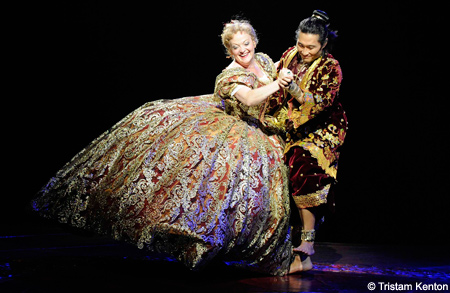
And finally, for all the extravagance of the production, the most affecting moment, and one that incited the audience of thousands to clap along, was “Shall We Dance?”—the exuberant polka that prim Anna teaches the King to dance to. Three million pounds spent on a production and the thing that gets people out of their seats is watching a couple of laughing, panting middle-aged actors gallop around the stage. It was a beautiful, joyful moment, and one in which the only sign that more money than normal was spent was her
INSANE DRESS, to which photos do no justice. It was also a moment that did not invite unfavorable comparisons to Yul Brynner (except inasmuch as any comparison to His Bald Majesty in any context must be unfavorable). There’s a famously sexy moment from the movie in which the king insists on dancing as the Europeans do, “not holding two hands”—when Brynner, a masterful physical actor, extends his hand as if it were something else, and fuses it to the corseted waist of the appropriately half-beswooned Deborah Kerr. Daniel Dae Kim seemed to grab Anna’s waist out of pure enthusiasm for the dance itself and his surprise at the suddenly intimate contact, and at Maria Friedman’s visible frisson, made them both for a moment seem like teenagers, and like equals. It had a freshness that can only come from two people standing on a stage, any stage, and allowing themselves to experience something real.

I saw a performance about a year ago at NYU’s summer lab, a workshop for students and alumni of the graduate theatre programs. Everything was as minimal as could be but the talent. It was basically a beautifully written play, acted brilliantly, some of which was due to the talent and skill of the actors and some of course to the director guiding them to make each scene and its place in the story, clear. That was all. Everything else either didn’t exist or had substitutions that were chosen without any attempt at convincing replication at all. Whiskey glasses were jam jars filled with water. Shovels and shoveling were mimed. Bones and skulls were planks of wood and balls of rubber bands. Murders happened with no rupturing of cleverly concealed packets of fake blood. Sound effects were narrated by the stagehand. There was no set, just a stage painted black and a table. It was one of the best, most moving plays I’ve ever seen, and a premier example of how poverty theatre, done well in the aspects that matter (writing, directing, acting), makes a fool of spectacular theatre. I dare any proponent of the hogwash idea that great theatre requires expenditure of fortunes--and that people go to the theatre for the razzle-dazzle, or that cynical, intellectually and creatively lazy cliché, “to escape”—to see something like that and suggest it would have been a more moving experience for the audience if the actors had used real-looking bones and real shovels and real dirt and real fake blood and monstrous set pieces and marvels of engineering and Spielburgian special effects. People who see theatre like this show I saw in the grungy pit at NYU go to the theatre regularly, because it gives them something more substantial than razzle-dazzle (and doesn’t cost $125 a ticket. I’m talking to you, Broadway). People who go to the theatre for spectacle go once a year, because that’s all they need to get their fix of what essentially can only nourish a part of them that doesn’t ask for much beyond the cheap thrill of expensive pageantry. People go to the theatre to be moved in one way or another, and if the only way you are able to move them is with grandiose money-flinging and a literal-minded slavery to realism, you are doing something wrong, and should not be surprised that most people would rather stay at home and watch television.

Unfortunately the production at the Royal Albert Hall was not videorecorded; I would love to include a clip of my favorite moment, although perhaps some of the magic of the live performance would be lost in conversion. So I’m including a clip from the movie. Swoon.

Sunday, September 19, 2010

On the rechristening of Henry Miller's Theater *update*

(I posted this as a note on my facebook page and got some interesting comments; I've included them here in the comments section below)


Sometimes I have to agree with Christopher Isherwood. There have been some stupid, crass, and embarrassing decisions made in the renaming of certain Broadway theaters. The renaming of the Plymouth and the Royale theaters after bureaucrats would be the worst examples if there weren’t also a Broadway house named for an airline company nobody even likes to fly with. Henry Miller's Theater was rechristened The Stephen Sondheim Theater the other night. This choice isn’t as bad as the first ones described here, but it is still an inappropriate one, and here’s why:


There’s no Broadway theatre yet named for either Arthur Miller or Tennessee Williams. Now, no matter how much Sondheim lovers love Sondheim, they cannot make a case for him having as great an influence over American cultural life as Williams or Miller. This is not a polemic on the quality of Sondheim’s work; I wouldn’t presume to be able to speak intelligently on the subject, and I have too many sensitive song-and-dance friends who would pout if I did. However, I don’t know anyone who isn’t already a musical theatre enthusiast who knows or cares either way about Sondheim or his musicals. But every American reads Death of a Salesman and A Streetcar Named Desire in school, and there is a reason for that. The influence of these writers and the importance of what they had to say extends beyond the realm of Theatre (where, aside from that Johnny Depp film, and a few episodes of Topper, Sondheim’s influence stops), into that of literature and even the way Americans see themselves. In fact, Arthur Miller reworked the basic formula for tragedy, which had not been tinkered with for over three thousand years, to state that “the common man is as apt a subject for tragedy in its highest sense as kings were.” The “heroic attack on life,” which from the birth of drama had been the exclusive domain of kings and gods, Miller imparted to the unknown, laboring, “small” man—the Willy Lomans, Eddie Carbones, and John Proctors of the world. In his essay, “Tragedy and the Common Man,” Miller writes,


“I think the tragic feeling is evoked in us when we are in the presence of a character who is ready to lay down his life, if need be, to secure one thing--his sense of personal dignity…. the fateful wound from which the inevitable events spiral is the wound of indignity, and its dominant force is indignation. Tragedy, then, is the consequence of a man's total compulsion to evaluate himself justly. In the sense of having been initiated by the hero himself, the tale always reveals what has been called his "tragic flaw," a failing that is not peculiar to grand or elevated characters. Nor is it necessarily a weakness. The flaw, or crack in the character, is really nothing--and need be nothing--but his inherent unwillingness to remain passive in the face of what he conceives to be a challenge to his dignity, his image of his rightful status.”


If it seems strange that that there were ever a question that this “compulsion to evaluate himself justly” is a universal, classless compulsion that drama must portray if it is to reflect the human condition accurately, it is because Miller had the insight to write a tragedy in the high tradition centered not on a king or a prince but on a traveling salesman. Drama has not been the same since.


How often does someone rework something that the ancient Greeks came up with and change it for the better? Not often. But Arthur Miller did. And with it, the way we think about heroism, fate, and the mirage of the American Dream.


We can take for granted that Sondheim changed, revolutionized, even, the musical both stylistically with his non-linear plots (which Miller also did first with After the Fall) and thematically in his divergence from the usual bright fare to darker, more introspective themes (which straight theatre had been doing for, again, several thousand years). But that says more about the musical as being a still-young art form, and about Sondheim’s great influence in helping it catch up with the other arts, than it does about him as an artistic force on the level of artists whose influence does what art should do, that is, change not only the mores and structures of its own genre, but of the society and culture that produced and witnessed it. If you write a book about the Chicago meatpacking industry, and the President of the United States reads it, throws his breakfast sausage out the window, and rallies his administration to create what eventually becomes the Pure Food and Drug Act of 1906, you have changed culture you live in, maybe even the world. If you create a character who personifies sensitivity, frailty, even spirituality, and place her in a losing match with one personifying brutality, pragmatism, and profanity, you’re holding a mirror up to a society in which those very forces are vying for primacy, and hopefully, inspiring people to guard as well they can what’s sensitive, frail, and sacred. If you write a play that makes not only Americans but people all over the world question the “American Dream” and the moral, human value of the characteristics that help one achieve success in a cold, inhuman, and corrupt system, you change the way people think about their own dreams and eventually, hopefully, how they will act. You have, in a way, changed the world. If you write a musical and it changes musicals, you haven’t changed the world; you’ve just changed musicals. Which warrants a name on a marquee, changing musicals or changing the way America thinks?

Saturday, May 22, 2010

Tuesday, March 16, 2010

Suddenly Last Summer


I haven't had much time to write or brain to think, but the show is going nicely, maybe. The director shows up once in a while to deliver some catastrophic notes which we do our best to assimilate the next night. We've gotten favorable reviews, here, here, and of course it's very gratifying to hear from happy audience members, some of whom reviewed the show on the site where they bought tickets, here. I've even run into people on the street who recognized me from the show and said some very kind things. Unfortunately the Chronicle only reviews smaller theaters when they produce a new play, or a west coast premier.
Still, one never really feels like one got it. Luckily, we've extended the run by two weeks, so I still have a while...

Saturday, November 28, 2009

R.I.P. Scottie Agar Jaickes


A friend of mine died a few nights ago. We worked together at my old theater company in San Francisco. I met him the summer I spent reading Steinbeck and so I've always associated the two of them--perhaps because Scottie shared the great author's sense of social justice, and perhaps because he lived on and worked a plot of land in northern California, and seemed like an ideal Steinbeck character: smarter, of course, and more self-aware than Lennie, but innocent and quiet, kind, innately intolerant of gossip, pettiness, and malice. His forearms were tattooed with bombs and other weaponry (which he jokingly or maybe not jokingly referred to as his "prison tatts") and he spoke in a rough street dialect, but I only ever knew him as gentle and wise, with an astute and disinterested sense of what's fair and what's not, someone you could speak with safely. His great strength as an actor was that he was bold enough to be dull onstage--and was therefore riveting. I think what turns a lot of people off the theater is that so much of the time you can sense an actor's anxiety about his own performance, in his perceptible over-eagerness to please, to provoke, to elicit sympathy, to convince, and worst, to entertain. At best, this is, in the revelation of the lack of self-trust at its base, unmoving or even embarrassing for the audience, and at worst, something that reads as pandering which the audience rightly rejects with disdain. You could always relax watching Scottie because you knew that he wouldn't subject you to any "acting." The limitations he placed on himself (he didn't do accents or adjust his already singular physicality from role to role) were made up for by an unfussy realism that made much of what passes on the major stages of the theater world look like desperate showing-off.

I'm not a psychologist and wouldn't presume to draw a link between Scottie's talent as an actor and his best traits as a person, but I'd like to think that they are connected. I will miss him, onstage and off.

Sunday, September 30, 2007

Edinb'rahhh and Moscow!

I know I was supposed to write a more in-depth account of my blow-out at my old magazine, but I can't be asked. Instead, I'm posting pictures of my recent travels to Edinburgh for the fringe festival and Moscow, for a short course I did with the great Moscow Art Theatre. Edinburgh Castle.

me with a deep-fried Mars bar. Brilliant.


evening at Red Square

Novo Devitchi Convent
We were instructed never to photograph soldiers, police or otherwise official-looking people, but I found that after I chased these ones down Tverskaya Boulevard, interrupted their attempt to buy cigarrettes, and apologized a lot (in charmingly broken Russian, I like to think, something like, "Forgive my Russian Tongue. She is a Wretchedness. I am sweet little students of the great Moscow's Art Theatrical. Please I can you both to photograph with my sweet little non-journalistic camera machine? You are very spectacular. Please don't cast away your bags from McDonald's. They are a very spectacle."), they were very accommodating.
Gogol.

Anyone on facebook can see many more pictures on my page. 'ooorrrrrah!

Sunday, August 20, 2006

To Whom it May Concern,

I am issuing a public plea, an appeal, if you will, to the hearts of my readers as a last humble effort to obtain the support I need to follow my dreams.

Sometimes I get a sneaking suspicion that acting is not a highly respected vocation. In fact, if my findings from my grant search are any indication, the world is actually more interested in finding a cure for cancer and promoting peace in the middle east than it is in cultivating the next generation of Shakespearean actors. Did you know that the Peace Corps has no theatrical division? And that you can’t get a deadline extension on the Fulbright?

When “philanthropists” like Warren Buffet and Bill Gates ignore my queries and Tony Hopkins won’t return my calls, I feel so hurt and confused by the lack of generosity in this world, I ask myself, “Where is the Love?”

Fifty thousand dollars seems so little to ask. What is it, a shiny new car? A downpayment on a house? Think of what you could be buying with your hard-earned money, if you stopped thinking about what the suburban middleclass bourgeois expected of you, and started thinking about what you expected of you…..

If I fail to inspire you, gentle readers, with the spirit of Giving, then for the length of my sojourn in London, I will have no choice but to eat conventionally-grown fruit, wash my face with tap water, and toil for 10-15 hours a week in some sweaty oppression inflicted by the school’s ministry of “Work!Study!” This will leave precious little time for Sloane-ing, coffeeshop blogging, or contemplation of The Beautiful. And from what I hear, the mines just don’t pay like they used to.

Imagine.

And do the right thing. Cash, personal checks, and applications for pre-nuptial divorce settlements gratefully accepted.

Sincerely, Larissa

Tuesday, January 31, 2006

Why One Should Always Carry a Handkerchief

I have a pair of Italian black leather gloves lined in cashmere which are not only quite cozy, but, I feel, the height of chicness and sophistication. They reach halfway to my elbow and shrug elegantly at the wrist. I've never been able to find women's gloves large enough for my elongated hands yet which honor the feminine daintiness of their shape, and have historically worn gloves best suited for mountain men whose paws have beefed up with much lumber-chopping and the regular strangling of bears. These gloves, however, are long enough to suit my aristocratic fingers, on which the nails often grow to form delicate curves beyond the fingertips (which are soft from unfamiliarity with manual labor), and manage to appear trim and ladylike as well. They both fit the size and reflect the personality of my legendary El Greco-esque hands. These gloves look best when accessorized with pearls, a blonde mink stole or perhaps a silver fox capelet, dark sunglasses and black leather shoes with T-straps and french heels.

Recently I noticed that the fingertips of my favorite gloves had hardened and seemed to be lined with some thin film of concrete. For a while I was puzzled over this phenomenon. The gloves looked the same, but the inside tips, as well as the lining of the outer edge of the index fingers, had grown hard and rough. I began to fear for my nails, which might split against their new shells, and for the silky skin which would surely callous in its harsh new environment.

Then one very cold day, as I strolled past Carnegie Hall, I saw a tall dark-haired man walking towards me. When our eyes met, I recognized him as Broadway star Liev Schreiber, Tony winner and director of Everything is Illuminated. I gave him my heartbreaking shy smile (which consists of a tiny hint of a smile with eye contact followed by a quick lowering of the eyes but sustaining of the mysterious smile. This is dubbed my "heartbreaking shy smile" because it indicates that though I am gracious enough to smile upon such a mortal, I know that sustained eye contact is vulgar, plus my thoughts are far too deep and spiritual to allow some stranger unrestricted access to them. This is to be distinguished from my "ball-breaking sneer," which includes an eyebrow arched in silent judgment and just a trace of a downward curl of the lips in what otherwise appears to be a smile. This suggests a worldliness and disappointment to which I'm too tactful to give name, but which, to the unfortunate recipient, is presumably unmistakable. Both the smile and the sneer, incidentally, can be termed "heartbreaking," but for different reasons: the former for its poetry, the latter for its implied rejection.). Schreiber rendered his own version of the heartbreaking shy smile (which would probably be more aptly termed the "celebrity-feigning-humility-in-the-face-of-assiduously-sought-after-public-recognition smile" or the "celebrity-grinning-foolishly-at-the-unfamiliar-sight-of-a-more-beautiful-and-fascinating-non-celebrity smile") and ambled past. Suddenly stretched inches taller with triumph, I still felt compelled to examine every expression and gesture that I had displayed in my passing acquaintance with the actor, and also to dissect his reactions to them, expecting to ascertain his instantaneous bewitchment with me. I was bewildered to discover myself lowering my hand from my nose and caught myself just as I was about to wipe it on my Scottish tweed skirt.

My god, had I been wiping my nose on my hand as I locked eyes with Liev Schreiber? In a moment of self-examination, in which the unconscious is made conscious, had I beheld a hideously childish and uncouth habit of mine, to which, for all I knew, I had been unwittingly subject all winter long and last winter in New York, the first and only winters I have ever spent in a climate cold enough to induce random post-nasal drippage? The slick evidence was right there on my fingertips.

Here is my scientific theory on the phenomenon of the hardened gloves: I wipe my nose on my gloves in a moment of obliviousness, the glazure seeps into the leather and settles in the fine knitted mesh of the cashmere lining. Here it freezes in the arctic chill of a typical December day in New York. At the end of the day when the gloves are resting on my kitchen table, the trapped moisture evaporates, leaving only the solidified mucus in the fingertips and, of course, the outer edges of the index fingers, where it is so convenient and natural to wipe one's nose as needed. The rock-hard barriers at the tips of my glove fingers and along the edges are in fact petrified snot.

The ace up my sleeve is that I can still wear my favorite Italian leather gloves with mink and pearls and French heels and look impossibly, devastatingly elegant, and no one is the wiser as to the secret of my mysteriously crisp handshake. No one, that is, but Liev Schreiber.

Wednesday, August 31, 2005

Soap Opera Angel

A brief anecdote from my day:
As I sat in the Actors Equity Center on Times Square at around 3 in the afternoon, having been there since 7:15am, I dozed off. This is hard to avoid on less busy days, as the seats are sublimely cushioned and there's always a mysterious low hum that acts as white noise and encourages sweet, sweet slumber for thespians too jaded to suffer pre-audition nerves. The rest pace the room mumbling and trying out different hand gestures to punctuate their monologues; most settle for smugly flicking their wrists against their thighs for contemporary drama and sawing through the air before them with rigid hands for Shakespeare. The reason I, as a non-union actor, am allowed to idle in the inner equity sanctum is because I achieved union candidacy with a show I understudied at Berkeley Rep. The non-union non-candidates have to sit on narrow wooden benches that line the hallways outside the lobby, getting their feet stepped on by people passing through and looking slightly less pathetic than the urchin cast of Oliver Twist. Neither do they have access to the equity bath and dressingrooms. Should nature call them while they await an audition call that might never come, they must exit the building entirely and visit the begrimed and often understocked bathrooms in the Times Square Tourist Information Bureau around the corner, or to the nearest Starbuck's 3 blocks away, and get stuck in a herd of tourists for ten minutes on the way. It is usually while one is off relieving oneself that one's name is called due to some miracle of equity non-attendance. How many promising careers, I wonder, have been flushed through the sewers beneath the crossroads of the world?
Back to my purportedly brief story: After several hours of fighting sleep with reading Simon Callow's Being an Actor, inwardly mocking all other white actresses in my age range present, and swaggering into the ladies' room whenever the fancy hit me to blot my lipstick or practice scales or even visit a stall, I sat in the cushioned chair and let my head drop to my chest and my eyelids flicker shut. I don't know how long I rested in this state, but somewherein my slumber I felt three delicate fingers on my knee, and a sugary voice inquire, "Pardon me, are you a member of SAG?" Roused, I looked up and squinted at the brightness of an ethereal Morgan Fairchild shining down on me, blonde locks backlit by the flourescent lights on the ceiling.
"...mnn-..no..."
She furrowed her brow and glided away, addressing herself to some other actors lurking by the sign-up sheets. Soon there was a cluster of animated, chattering, apparently SAG-involved actors around the star, beaming as she described the changes she will make to the Screen Actors Guild policies if she is elected president. After half an hour or so, two Equity moderators emerged from their office (which stank of the take-out meals of a decade) and gingerly informed her that campaigning was not permitted in the Equity building, after which she made her adieus, all gleaming teeth and blonde finesse, and left with her two cronies. As she passed me in my sleeping-chair, she brushed my knee again with her fingers(this time I noticed her blood-red manicure) and winked, a faint and wicked smile on her lips.
Such is a day in an actor's life.